

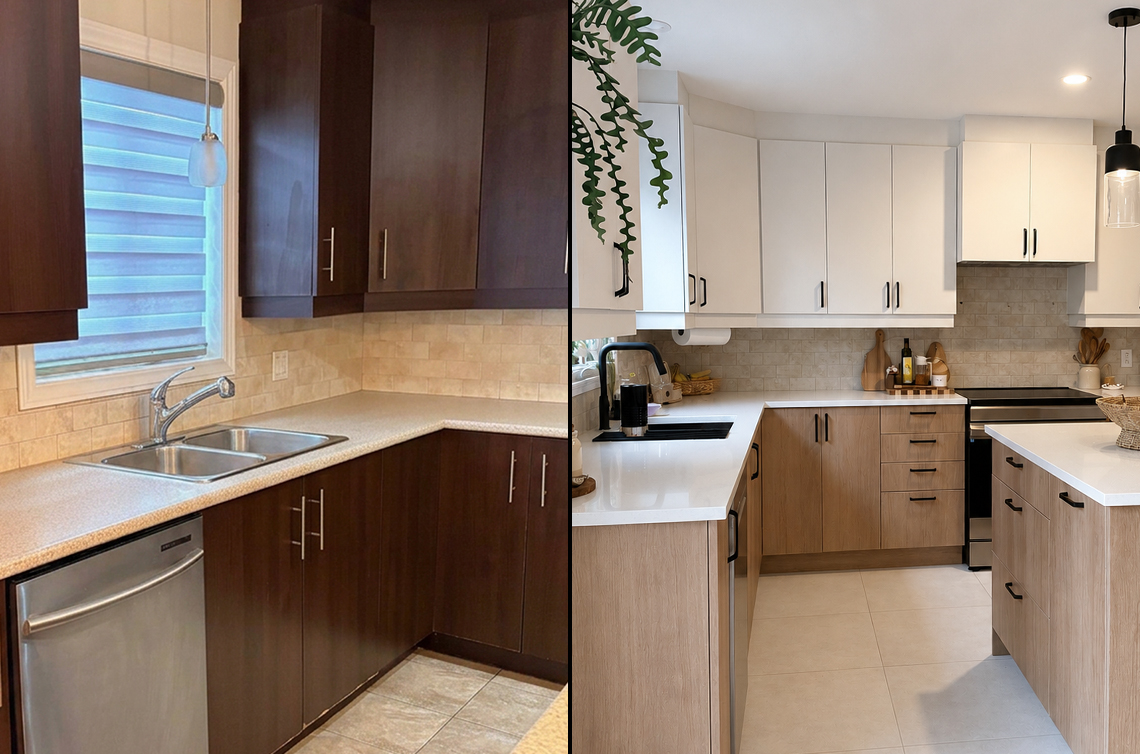
The durability of kitchen cabinet refacing is naturally one of the first questions to consider before transforming an existing kitchen. After all, this space is part of rushed breakfasts, family meals, dinners with friends, and countless everyday moments. In Montreal, a renovated kitchen therefore needs to be just as functional as it is visually appealing. The good news is that the durability of a cabinet refacing project depends on very concrete factors: the condition of the existing cabinet boxes, the choice of materials, and the quality of the workmanship.
At Cuisine Summum, we have been completing kitchen cabinet projects since 1983 and have specialized in cabinet refacing for more than 20 years. The process involves keeping the existing structure when it is suitable for the project, then renewing the elements that define the kitchen’s appearance and part of its functionality.
The durability of kitchen cabinet refacing starts with the cabinet boxes
Before discussing new doors, colors, or handles, it is important to look at what lies behind the transformation: the existing cabinet boxes.
Refacing is particularly relevant when the cabinet boxes are strong, stable, and functional enough to be retained. Evaluating their condition therefore makes it possible to determine whether this solution is truly appropriate for the kitchen. Cabinet boxes that are severely damaged, swollen from moisture, or poorly installed may require more extensive work.
This is an essential point when discussing longevity. Refacing does not simply mean hiding an old kitchen behind new doors. It is based on reusing a structure that still has the qualities required to continue serving its purpose.
When refacing becomes a logical option
A refacing project is especially worth considering when:
- the existing cabinet boxes are in good condition;
- the overall kitchen layout still meets your needs;
- you mainly want to transform the appearance of the cabinets;
- you want to modernize the doors, drawer fronts, and hardware without necessarily rebuilding the entire kitchen.
The existing layout is generally maintained during a refacing project. Wall and base cabinets therefore usually remain in place, along with the main elements of the current configuration.
What is actually replaced during cabinet refacing?
The transformation goes far beyond a simple change of color.
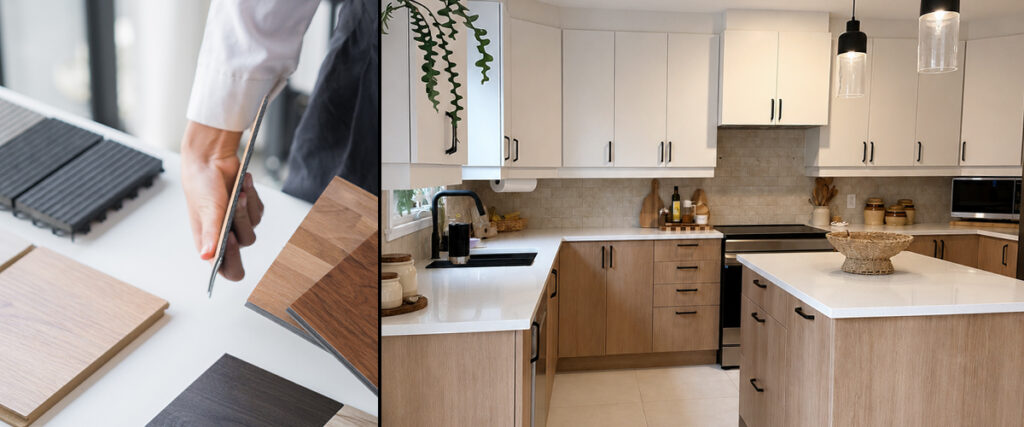
At Cuisine Summum, the existing doors are replaced with new custom-made doors. The hardware is also renewed, including hinges and handles. The exposed cabinet sides and the edge strips around the cabinet boxes are then covered to create a consistent overall finish.
Depending on the project, refacing may also include:
- replacing or adding crown molding;
- light valances and base moldings;
- adding glass-front doors;
- adding drawers;
- floating shelves or other storage accessories.
This approach makes it possible to preserve the parts of the existing structure that are still suitable while renewing a large portion of the kitchen’s visible surfaces.
The choice of materials also affects durability
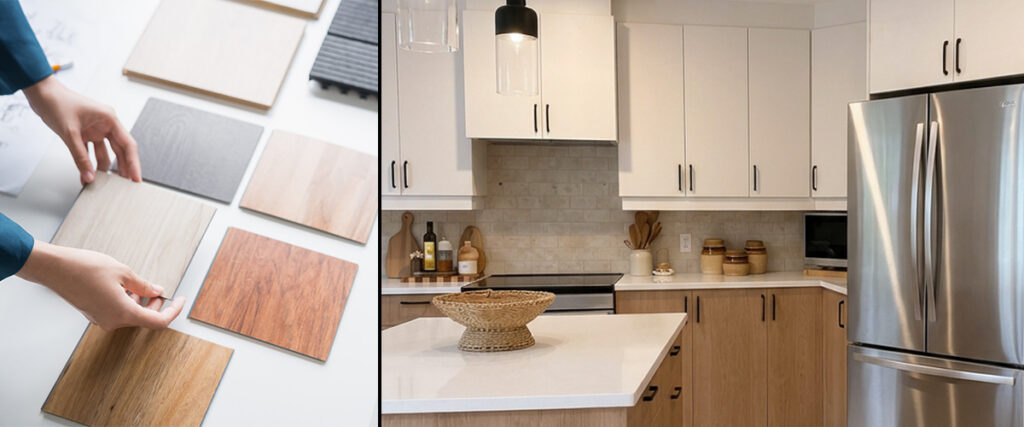
Not all refaced kitchens are the same. The choice of new doors and their material is one of the important variables in the project.
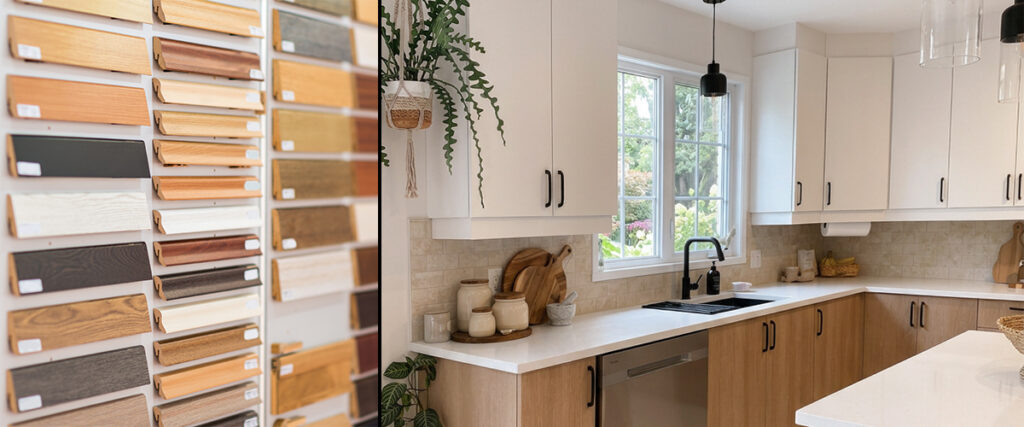
Among the options presented by Cuisine Summum are thermoplastic, melamine, wood, and veneer. The available choices vary in price, appearance, and durability.
It is therefore preferable not to choose a door simply because a particular color looks appealing on a sample. The material, desired finish, budget, and way the kitchen will be used should all be part of the decision-making process.
A heavily used family kitchen does not necessarily have the same priorities as a kitchen used only occasionally. This is precisely why the choice of components should be considered as part of the project as a whole rather than being limited to an aesthetic decision.
Cuisine Summum in Montreal: more than 20 years of refacing experience
At Cuisine Summum in Montreal, our experience in kitchen cabinet manufacturing dates back to 1983. We complete both new kitchen and refacing projects, using materials selected with quality in mind. Our expertise in refacing spans more than 20 years.
This experience is particularly relevant when determining whether an existing kitchen is suitable for refacing.
Before transforming the cabinets, it is important to understand what can advantageously be retained and what should instead be replaced. The project can then be built around the actual condition of the kitchen rather than applying the same solution to every home.
Can a precise lifespan be given for cabinet refacing?
It may be tempting to answer with a specific number of years. However, that would oversimplify a reality that depends on several factors.
The initial condition of the cabinet boxes varies from one home to another. The selected materials may also differ, as can the way the kitchen is used.
It is therefore more relevant to evaluate the conditions that contribute to a durable project:
- An existing structure worth keeping. The strength and overall condition of the cabinet boxes are the starting point.
- Materials suited to the project. The material used for the new doors affects factors such as durability, appearance, and price.
- Complete execution of the refacing project. The doors, hardware, exposed sides, and various finishing elements should form a consistent whole.
The goal is therefore not to promise a universal lifespan, but rather to create a project suited to the existing structure and the homeowner’s expectations.
What about maintenance after refacing?
Maintenance should be considered from the moment materials are selected.
Because refacing can involve different materials and finishes, there is not necessarily one single maintenance method that applies to every cabinet door. The appropriate care instructions should correspond to the components actually selected for the project.
This is another reason why it is important to understand the chosen material before making a decision. A wood, melamine, thermoplastic, or veneer door does not represent exactly the same type of finish. Cuisine Summum offers several options to adapt the kitchen’s appearance to the desired project.
Refacing instead of replacing everything: a targeted transformation
When a kitchen still has a sound structure and a functional layout, it is not automatically necessary to tear everything out to achieve an updated look.
Refacing specifically reuses the existing cabinet boxes. This approach results in less demolition, dust, and debris than a complete renovation. Cuisine Summum also indicates that a refacing project generally requires fewer installation days because a significant portion of the structure remains in place.
The transformation is easy to imagine: the same familiar layout, the same space where morning coffee is prepared, but with new doors, coordinated surfaces, new hardware, and a completely updated style.
That is the main advantage of refacing when it is suited to the existing kitchen: transforming what needs to be changed while keeping what still works.
A durable project starts with a proper evaluation
The durability of kitchen cabinet refacing ultimately cannot be reduced to a promise expressed as a specific number of years. It begins with a much more practical question: is your current kitchen a good candidate for refacing?
If the cabinet boxes are solid and the existing layout still meets your needs, this option may be worth exploring. If the structure has significant problems or if you want to completely redesign the layout, a new kitchen may be a better fit for your project.
At Cuisine Summum, we can evaluate your kitchen and discuss the available refacing options with you. Our team is located at 4146 Majeau Street in Montreal North, and quote requests can also be submitted directly to our team.
FAQ about the durability of kitchen cabinet refacing
1. How long does kitchen cabinet refacing last?
There is no universal lifespan that applies to every project. Durability depends in particular on the condition of the existing cabinet boxes and the materials selected. Refacing should therefore be evaluated based on the specific kitchen involved.
2. How do I know if my cabinets can be refaced?
The cabinet boxes should be evaluated based on factors such as their strength, stability, overall condition, and configuration. Cabinet boxes that are severely damaged or affected by moisture may require more extensive work.
3. Are the doors replaced during cabinet refacing?
Yes. At Cuisine Summum, the existing doors are replaced with new custom-made doors. The hinges and handles are also renewed, and the visible surfaces of the cabinet boxes are covered to create a consistent overall finish.
4. What materials can be used for the new doors?
Cuisine Summum presents options including thermoplastic, melamine, wood, and veneer. The choice of material affects factors such as the price, appearance, and durability of the project.
5. Does Cuisine Summum only offer cabinet refacing?
No. Cuisine Summum completes both cabinet refacing and new kitchen projects. The company also provides support for various types of work related to kitchen projects, including carpentry, electrical work, plumbing, and tile installation.